
Politics · 3 days ago
He Said No to Bush. Now He Wants to Say No to Le Pen: Dominique de Villepin Is Officially Running for President of France
The Outsider's take
The Outsider · Politics / France 2027 · Analysis
20 Nov 2026
In 2003 he told the most powerful country on earth that it was about to make a historic mistake, and he was right. In 2026 he is telling France the same thing about itself. The question is no longer whether Dominique de Villepin can speak. It is whether anyone is still listening to the kind of politics he represents.
The thesis
This article sets out to answer one question: should Dominique de Villepin's candidacy be taken seriously? The conventional answer is no. He polls at around 3%, has no party machine, no parliamentary group and, by most reports, only about half of the 500 sponsorships he needs. Our answer is more nuanced. The numbers are against him, but the conditions of this election give him a credible path that few commentators are willing to consider. Outsiders with weaker hands have shocked their countries before.
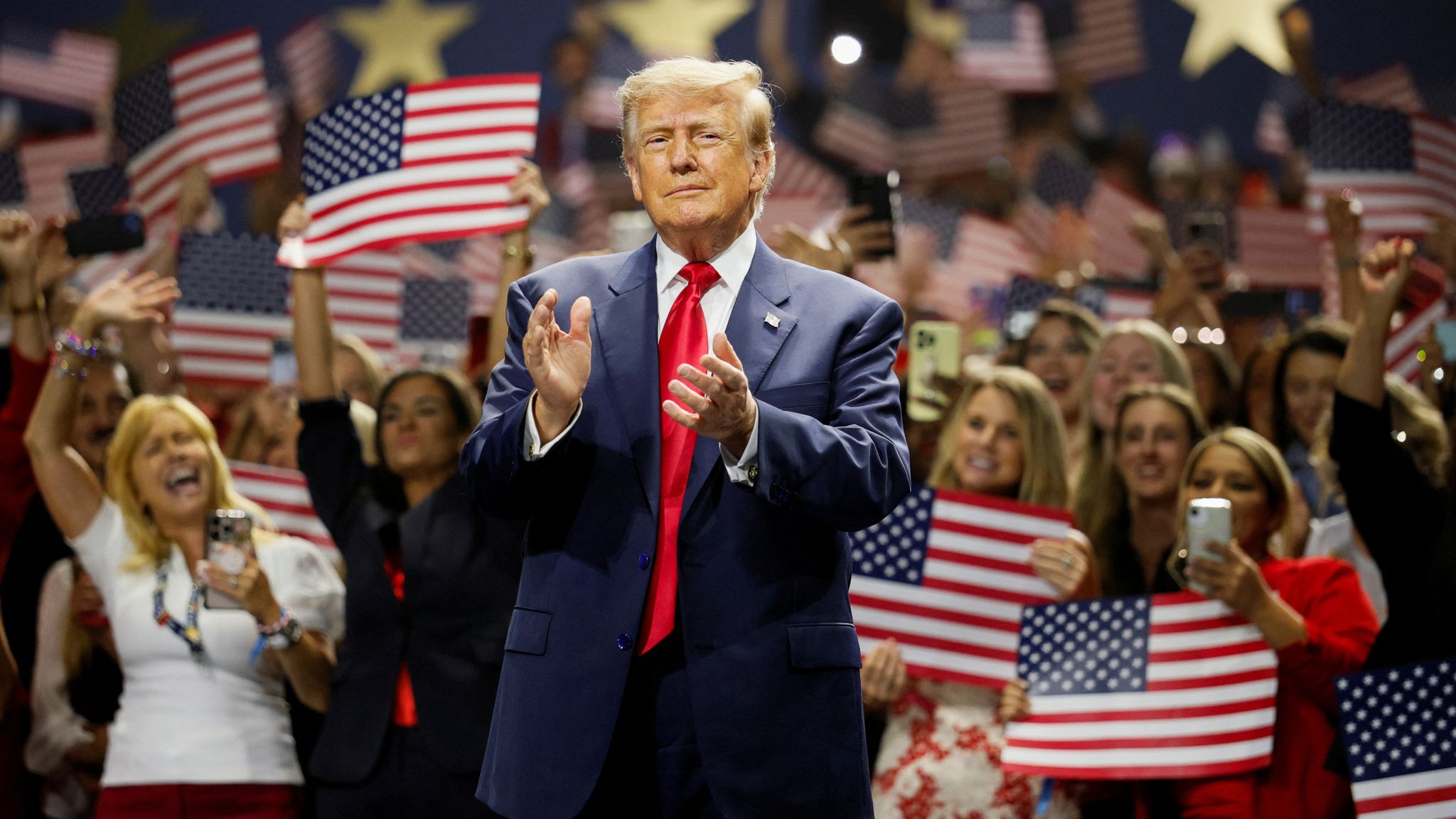
Think of Donald Trump in the summer of 2015. Pundits laughed, his own party's establishment treated him as a sideshow, and early polls placed him in a crowded field of more "serious" candidates. Eighteen months later he was in the White House. The lesson was not about ideology, and Villepin is in many ways Trump's opposite: a diplomat, a multilateralist, a man of the Republic's institutions. The lesson was about conditions. When voters despise the system, a candidate who stands outside it and speaks louder and better than everyone else can rewrite the rules of a campaign.
France in 2026 shows several of those conditions: a deeply unpopular outgoing president, a centre unable to agree on a single candidate, a far right at the gates and a radical left that frightens as many voters as it inspires. That does not make Villepin a favourite. It does make him more than a relic: a candidate whose message, a refusal of all the dominant blocs, could find an audience far larger than his current polling suggests.
Friday's announcement:
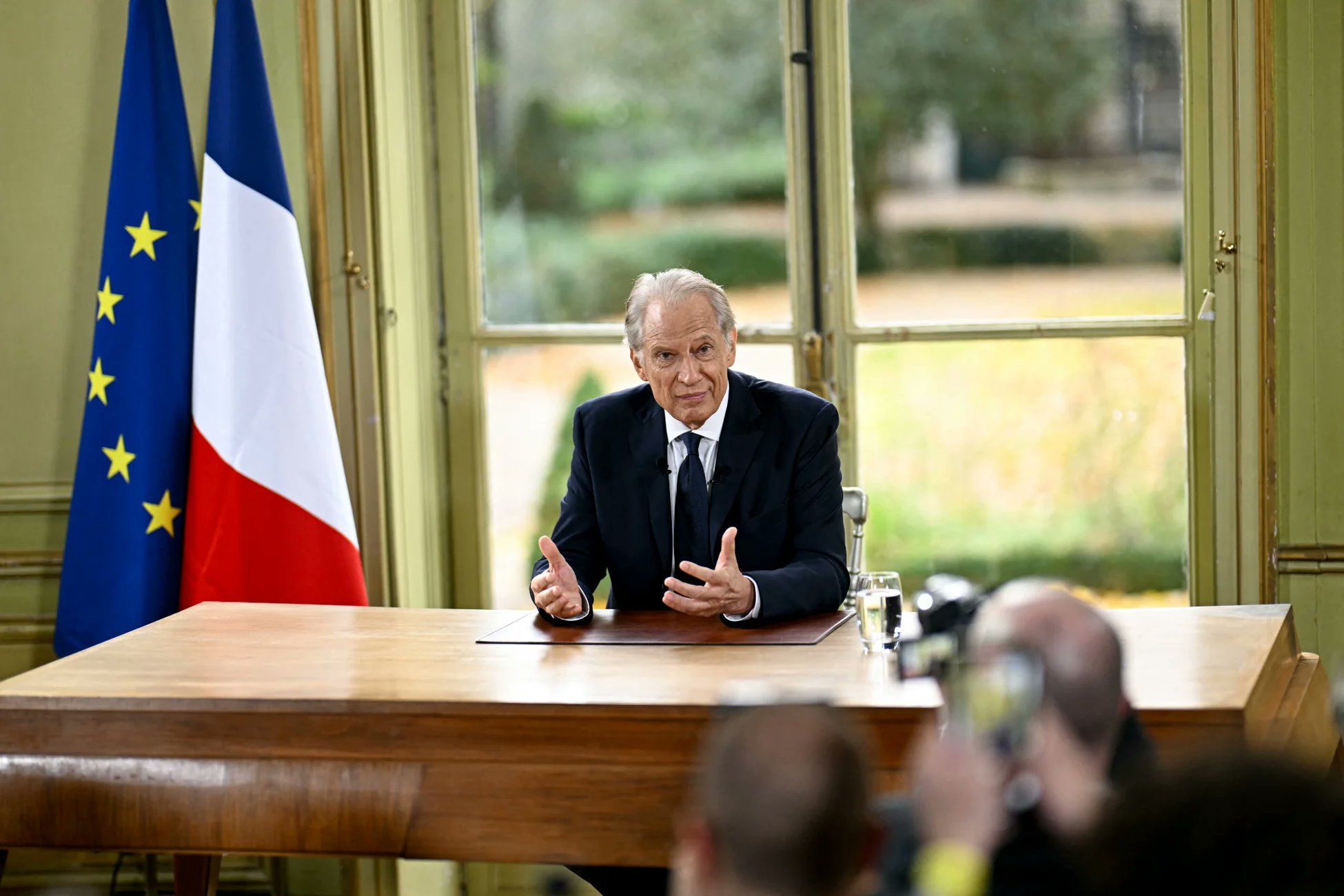
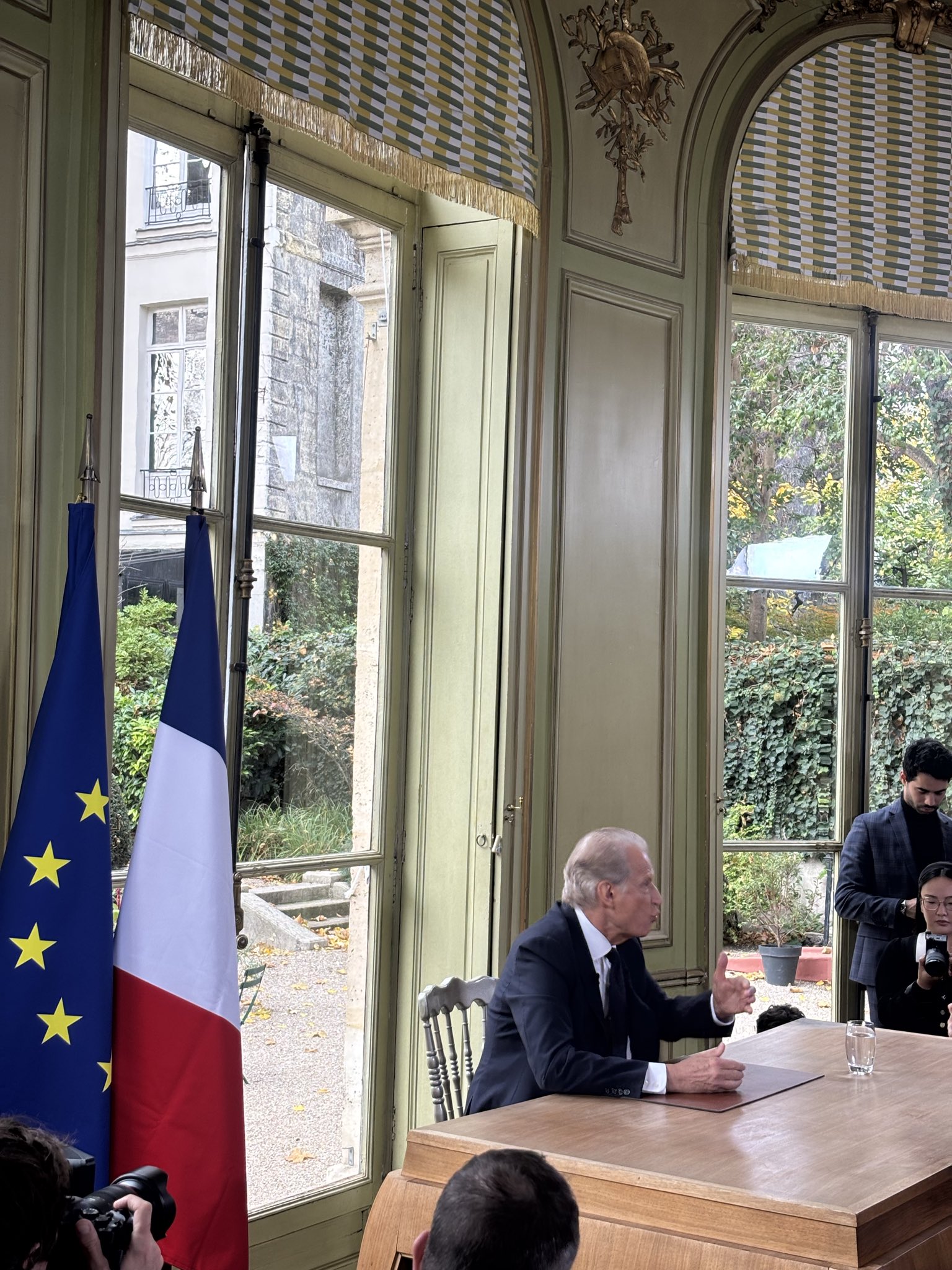
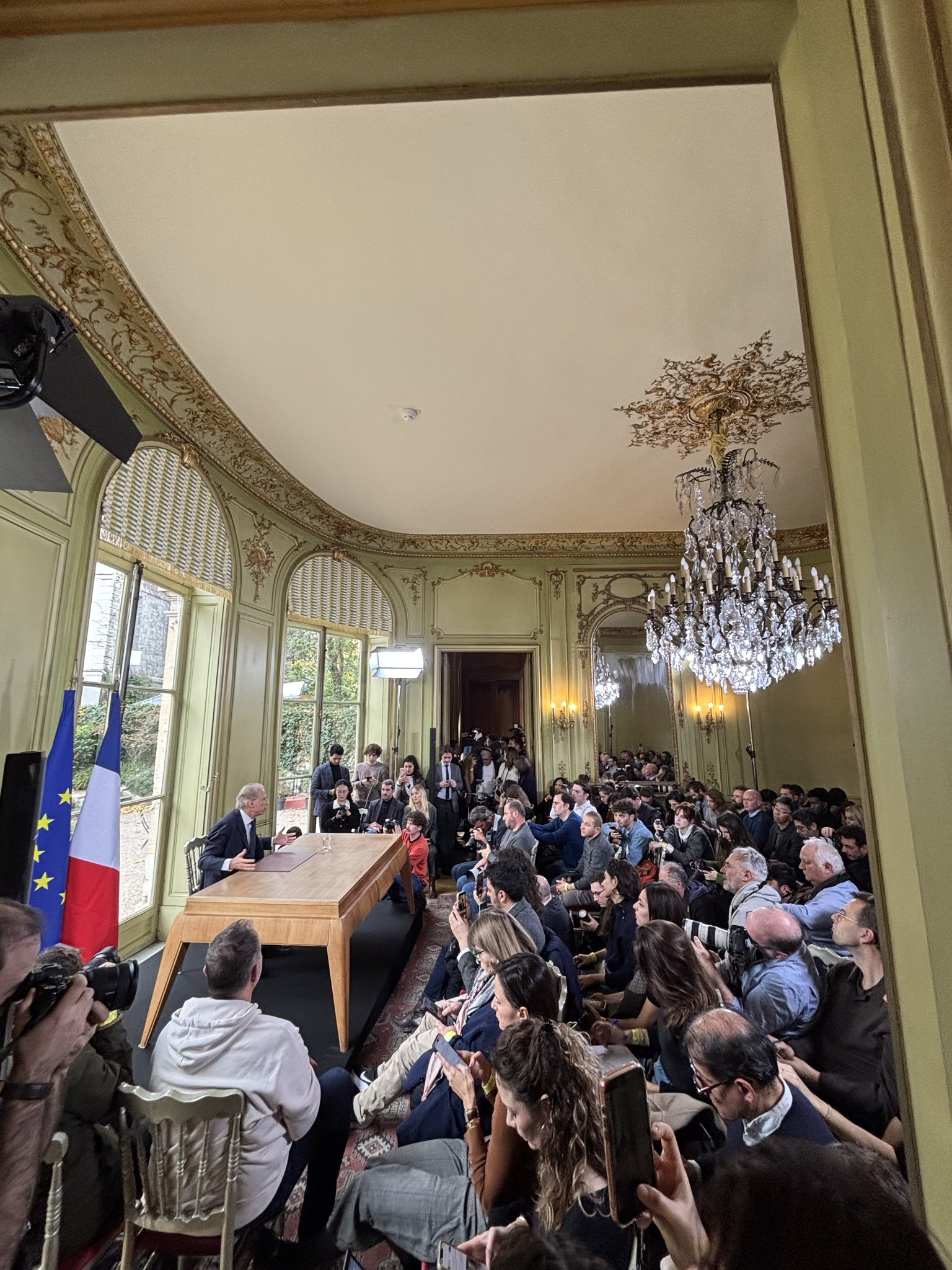
On Friday morning, at the Maison de l'Amérique latine in Paris, in front of around a hundred journalists, the 73-year-old former prime minister ended a year of calculated hesitation: "Je suis candidat à l'élection présidentielle de 2027."
He named his enemies with precision: Macronism, La France insoumise and the Rassemblement national. Together, he argued, they have produced the "pourrissement", the rotting, of the country. He described a "ghost president", a "spirit of defeat" and a "mechanics of civil war". He accused the RN of carrying "a legacy of racism and antisemitism" and called LFI's programme disconnected from reality.
Then came the slogan, almost disarming in its softness: "Si on s'aimait encore", "If we loved each other again". In a campaign of anger, he is betting on reconciliation. It is either naive or very clever.
The speech that made him: New York, 14 February 2003:
To understand why a man polling at 3% still commands this much attention, you have to go back 23 years.
On 5 February 2003, US Secretary of State Colin Powell stood before the UN Security Council and presented the American case that Saddam Hussein possessed weapons of mass destruction. Washington wanted a mandate for war. Nine days later, France's foreign minister answered.
Villepin spoke for about fifteen minutes. His argument was not pacifist; he did not rule out force as a last resort. It was procedural and moral at once: the UN weapons inspections were producing results, so give them time. War, he argued, should be the sanction of failure, not a shortcut around diplomacy. He warned that an invasion could destabilise an already fractured region and feed the very terrorism it claimed to fight. And he closed with the line every French student of diplomacy knows, speaking for "un vieux pays, la France, d'un vieux continent comme le mien, l'Europe": an old country, from an old continent, that had known war, occupation and barbarity, and still chose to stand for peace.
Then something almost unheard of happened. The Security Council, a chamber where applause is simply not done, applauded.
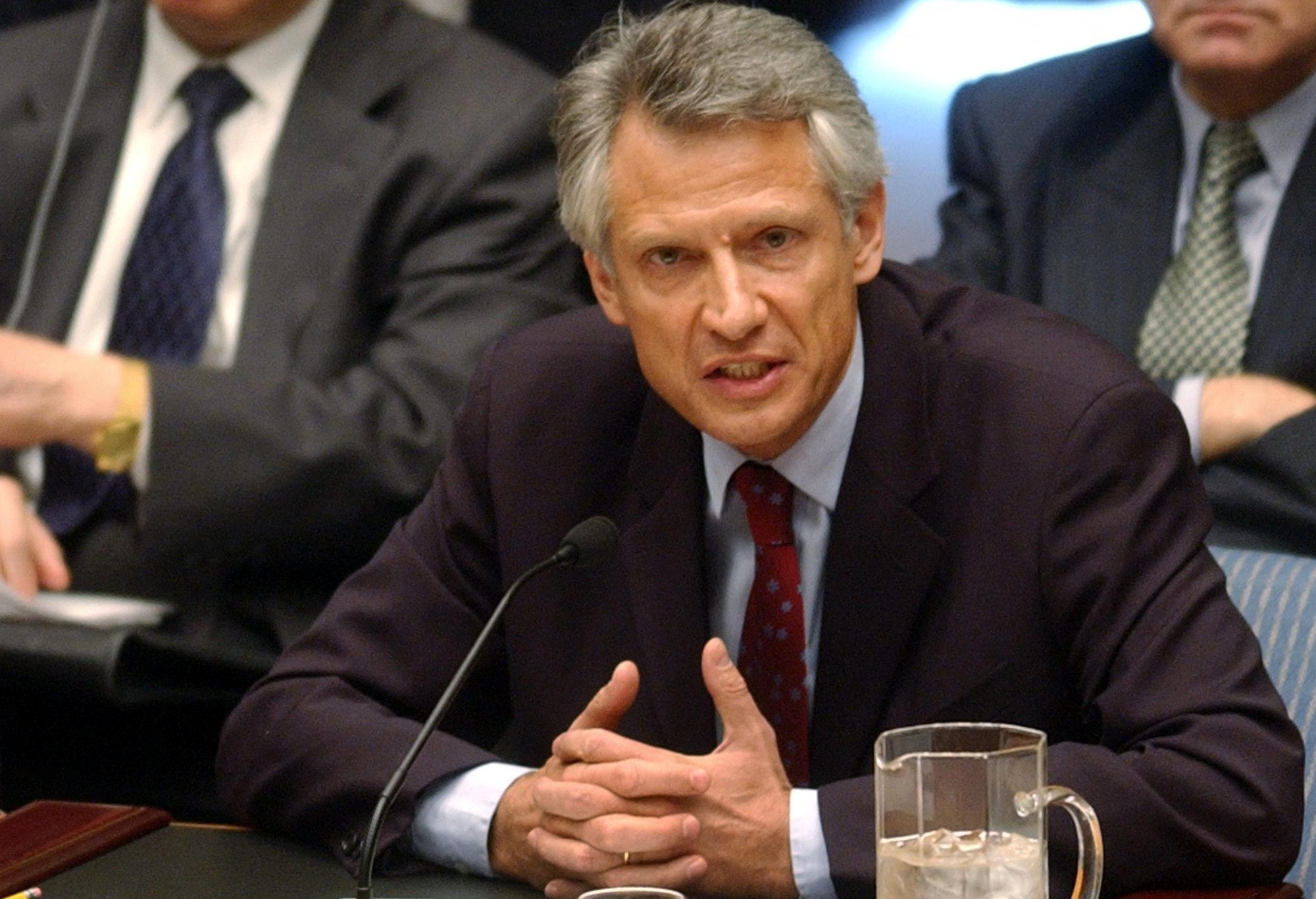
The United States went to war anyway in March 2003, without a UN mandate. No weapons of mass destruction were found. What followed, from the collapse of the Iraqi state to the rise of the Islamic State, matched Villepin's warnings closely enough that the speech is now taught as one of the great diplomatic texts of the century.
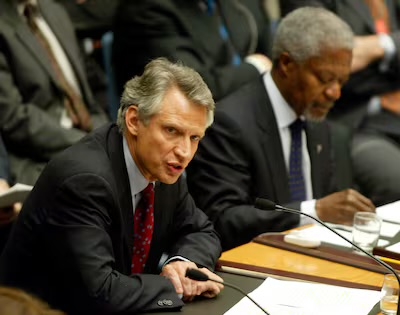
That speech is Villepin's entire political brand. It is the proof that he can say no to power and be right. His recent surge in popularity, built on his fierce criticism of Israel's war in Gaza, runs on exactly the same fuel. For millions of French people, especially young ones, he is the man who said no, and who is saying it again.
The record: brilliant, uneven, contested
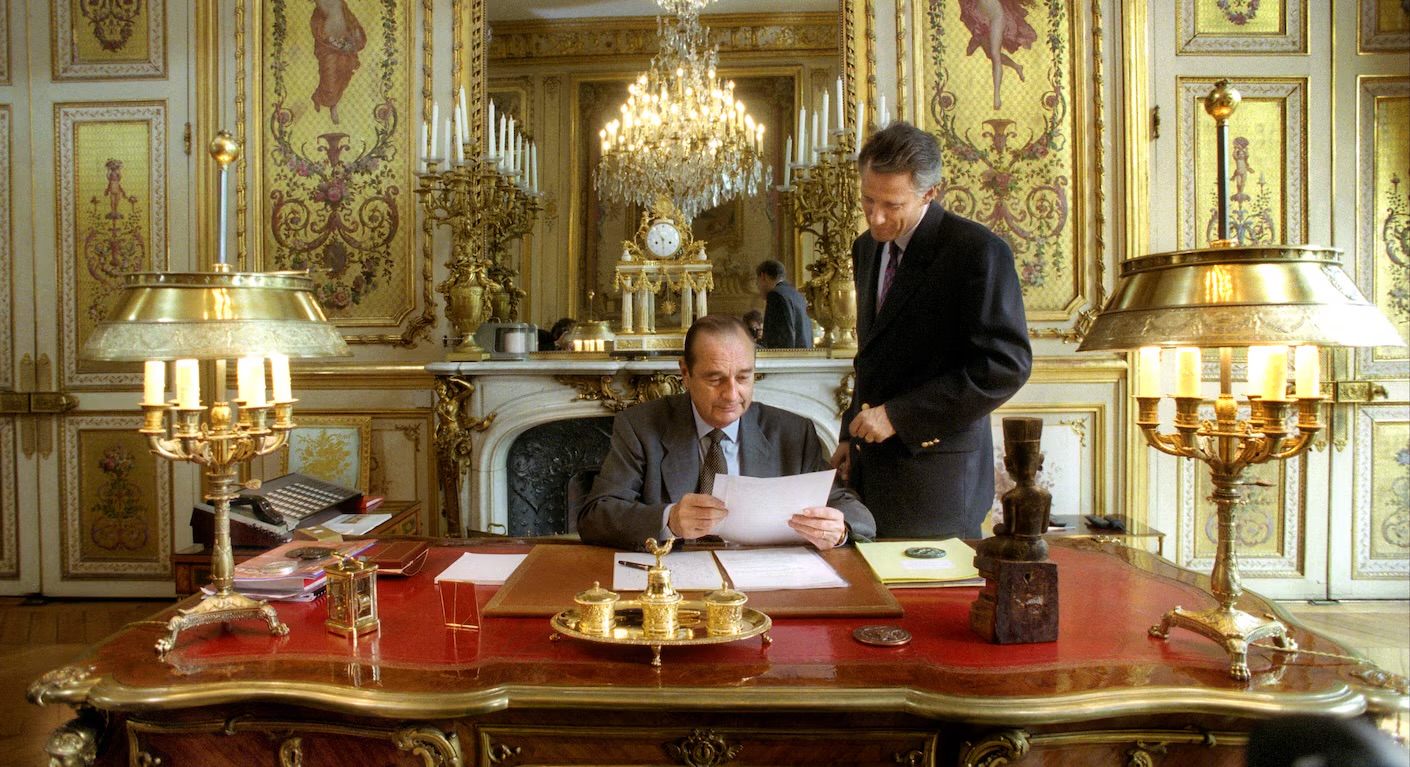
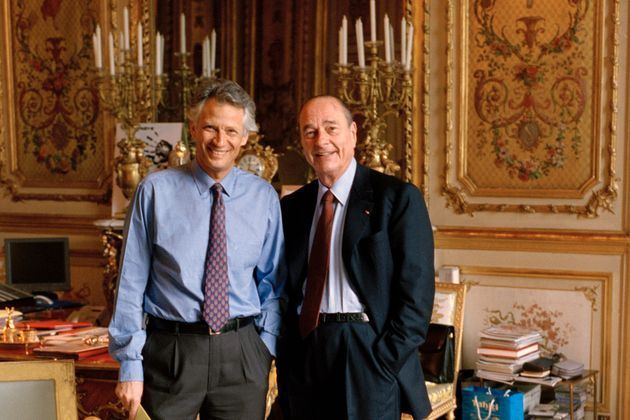
An honest assessment has to hold both columns at once. Start with the achievements. Villepin is a diplomat of the first rank. A career diplomat, he became Secretary-General of the Élysée under Jacques Chirac from 1995 to 2002, placing him at the heart of the French state for nearly a decade. As foreign minister from 2002 to 2004, he led the international coalition against the Iraq war, with Germany, Russia and China lining up behind France's position at the UN. It remains the last time Paris visibly shaped a global crisis. He then served as interior minister before Chirac named him prime minister in May 2005, in the wreckage of the failed referendum on the European constitution. His government made employment its top priority, and unemployment fell steadily during his two years at Matignon. Beyond office, he is that rare thing in a political class of technocrats: a writer and historian, author of books on Napoleon, power and poetry, who thinks in centuries rather than news cycles.
Now the failures and the shadows.
The defining one is the CPE of 2006. His "first employment contract" for under-26s, which allowed young workers to be dismissed without justification during a two-year trial period, triggered massive student and union protests. Universities were blockaded, and the government withdrew the measure in April 2006. For a man now courting young voters, this is the uncomfortable precedent: the last time he governed, the youth of France marched against him. Under his premiership, the suburbs also burned for three weeks in the riots of autumn 2005, and a state of emergency was declared. The sale of France's motorway concessions on his watch is still widely criticised as a gift of public assets to private groups. The Clearstream affair, in which he was accused of helping smear Nicolas Sarkozy with forged banking lists, ended in acquittal in 2010, confirmed on appeal; legally closed, politically scarring. And in May 2026, France's financial prosecutors opened a preliminary inquiry into two Napoleon statuettes he received as foreign minister. He admitted that accepting them was "an error" and returned them. No charges have been brought, but the timing is brutal.
The verdict?
Villepin is a man of exceptional
vision and uneven execution. His greatest moments were moments of speech. His greatest failures were moments of governing. Voters are entitled to ask which version would sit in the Élysée.
Villepin vs Sarkozy: a twenty-year feud that never ended :
You cannot understand Villepin without Nicolas Sarkozy. For two decades, the two men have embodied the great civil war of the French right: Villepin, the Chiraquian loyalist, diplomat and man of the state who had never faced voters; Sarkozy, the conqueror who seized the party from its base. They served in the same governments, Sarkozy even as interior minister under Prime Minister Villepin, and never hid their mutual contempt.
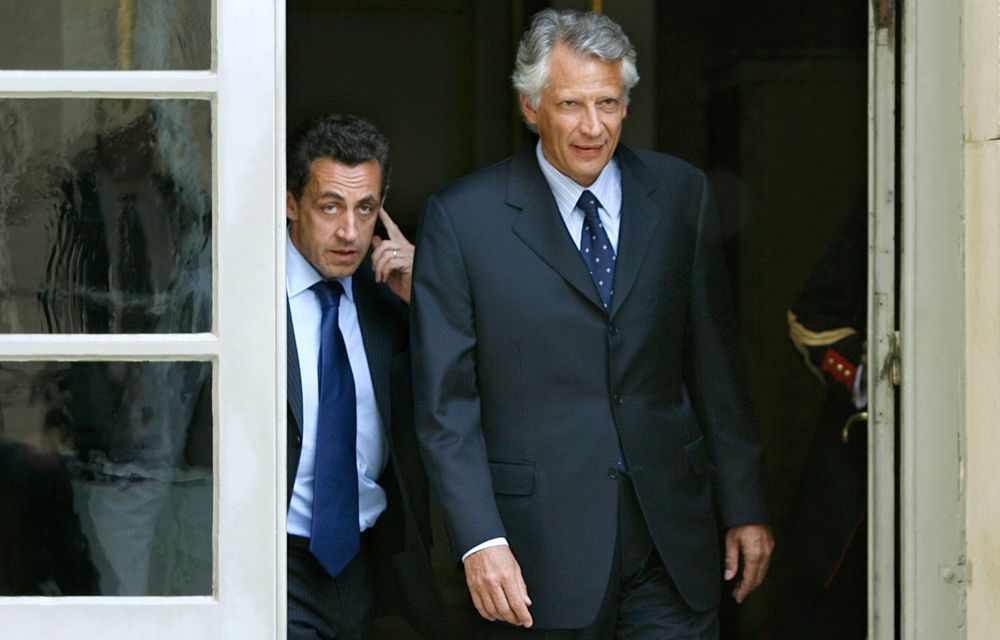
The first round went to Sarkozy. In 2006, the CPE protests destroyed Villepin's authority and with it his hopes of succeeding Chirac. Sarkozy took the party's nomination and won the presidency in 2007. Then came Clearstream, the darkest chapter: forged banking lists falsely linking Sarkozy to secret accounts, and Sarkozy, as a civil party, pursuing Villepin in court, famously vowing to hang those responsible on a butcher's hook. Villepin was acquitted in 2010, and the acquittal was confirmed on appeal in 2011. He then tried to run against Sarkozy in 2012, and failed to reach the ballot. Twenty years on, the feud is back at the heart of the 2027 campaign. The statuettes affair was revealed by Robert Bourgi, a lawyer and longtime friend of Sarkozy, who also brought down François Fillon's campaign in 2017 with the affair of the expensive suits. Bourgi denied that Sarkozy had anything to do with it, but said he resented Villepin's comments during Sarkozy's brief imprisonment last year and wanted to do everything to stop him reaching the Élysée. Villepin's camp called the revelations a political score-settling and a smokescreen at a time when Sarkozy was once again facing the courts. Sarkozy's entourage dismissed Villepin's insinuations as ridiculous and unfounded.
And the timing could hardly be more dramatic. Sarkozy, sentenced at first instance in 2025 over the alleged Libyan financing of his 2007 campaign and briefly jailed before being released pending appeal, will hear the appeal court's verdict on 30 November, ten days after Villepin's declaration. Sarkozy maintains his innocence, and the appeal court may confirm, reduce or overturn the conviction. Whatever the outcome, the two old rivals will once again share the front pages: one fighting to clear his name, the other fighting to make his comeback.
The symbolism matters for 2027. Sarkozy's political heirs pulled the right toward a harder line on identity and security. Villepin represents the road the right did not take: Gaullist, multilateral, socially minded. In a sense, this campaign is the rematch of a duel the right settled in 2007, and whether the right would settle it differently today is one of the open questions of 2027.
The programme: a Gaullist cocktail:
His platform, around 230 measures according to Ouest-France, is ideologically promiscuous by design. From the left, he borrows roughly €200 extra net per month for employees, electricity bills cut by 15%, 500,000 new homes a year, a mass rollout of health centres to fight medical deserts and the abolition of the tax loopholes he calls "privileges". From the right, he takes fiscal discipline, promising a deficit below 3% of GDP by 2031, and a strong state. From Gaullism, he takes his vision of institutions: a president as "arbiter", the return of the referendum, unions, employers and regions associated with decisions, and real equality between women and men written into Article 1 of the Constitution.
Critics will say this is a list, not a project, and that promising more purchasing power and a lower deficit at the same time is the oldest trick in French politics. They have a point. Even sympathetic observers note that Villepin is long on eloquence and short on detail. If he wants to be taken seriously, the costing will matter as much as the poetry.
Challenging the myth of the "empty centre"
The popular narrative says Villepin is stepping into a vacuum: the last republican of the right, standing alone in a centre that has fallen silent. It is a seductive story. It is also wrong.
The centre is not empty. It is overcrowded and at war with itself. Édouard Philippe polls between 10% and 15% and refuses any primary. Gabriel Attal, Bruno Retailleau and David Lisnard are building one without him; their teams met on 17 November with Philippe's chair left empty. Senate president Gérard Larcher has publicly urged them to find a way to settle on one candidate. Villepin, for his part, has already declined Attal's invitation to join a primary.
Nor is he the only figure of the right refusing the far right: Philippe and Attal also reject any deal with the RN. What makes Villepin unique is not his opposition to Le Pen. It is where his support comes from. His popularity is strongest not among right-wing voters but on the left, particularly among LFI sympathisers moved by his stance on Gaza.
This is the real paradox of his candidacy: a Gaullist of the right whose audience sits on the left. He is not filling a vacuum in the centre. He is attempting something far more ambitious and far more fragile: building a bridge between voters who usually never meet.
The battlefield
The mid-November polls from Ifop, YouGov, Elabe and OpinionWay tell a stark story. Marine Le Pen dominates the first round with 32 to 36%. Jean-Luc Mélenchon follows with 16 to 19.5%. Édouard Philippe sits between 10 and 15%, Raphaël Glucksmann between 8 and 14%, while Attal, Retailleau and Lisnard hover in single digits to around 10%. Villepin, where pollsters have tested him, registers around 2 to 3%.
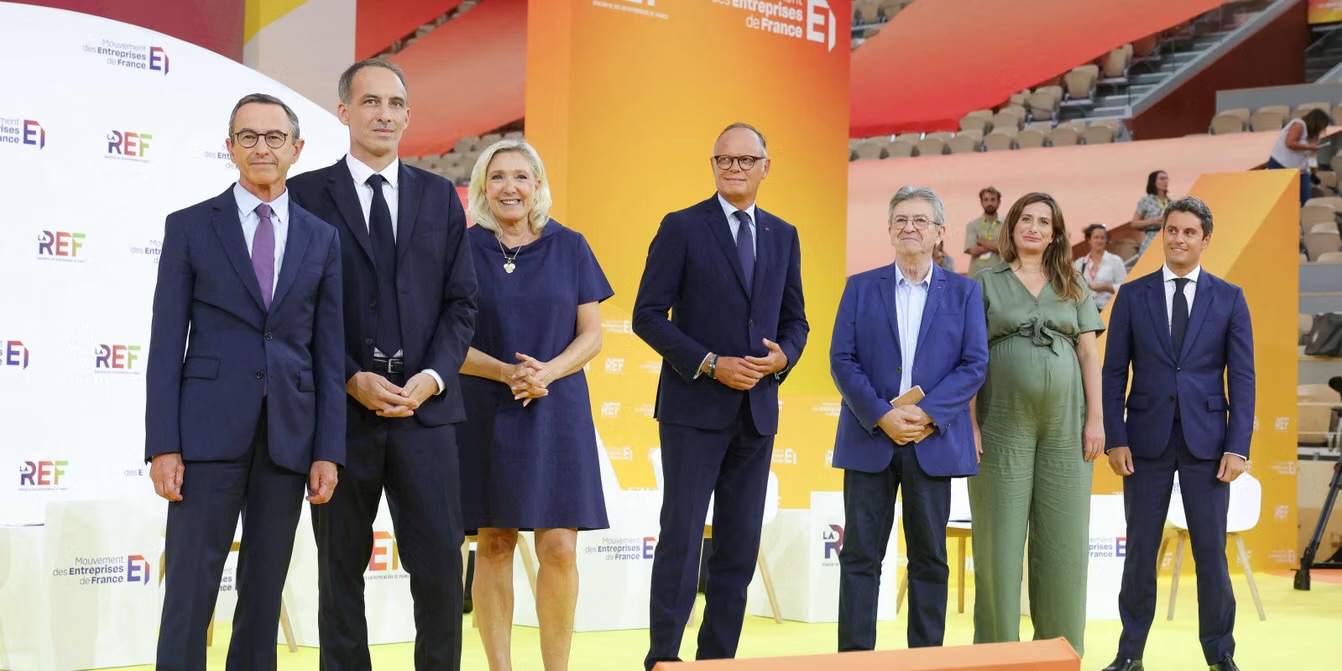
Le Pen is back in the race after a Paris appeal court in July cut her ineligibility to 15 months, already served, while sentencing her to three years, one of them under electronic tag. Her appeal to the Cour de cassation should be decided by early January, and Jordan Bardella waits in the wings. In second-round polls she currently beats every opponent tested, Philippe and Glucksmann included, by around ten points.
French politics has hardened into what political scientists call a tripartition: a nationalist bloc, a radical-left bloc and a fragmented liberal centre. In a two-round system, the first round is a survival contest. Fragmentation is fatal.
How the surprise happens
The Villepin scenario is not fantasy. It follows a clear sequence. First, he clears the signatures wall, and every mayor who signs becomes a local ambassador. Second, he turns foreign policy into a coalition: Gaza and France's place in the world mobilise a large, young electorate that feels unrepresented, and his only rival for it is Mélenchon, who repels far more voters than he attracts. Third, he wins the debates, because no one in the field can match him as an orator and a televised campaign rewards exactly that. Fourth, he profits from the centre's civil war: if Philippe, Attal, Retailleau and Lisnard spend the winter fighting over a primary, their voters will look for someone above the fray. Fifth, he becomes the useful vote against the far right. Polls show Mélenchon losing heavily to Le Pen in a runoff; as left-wing voters absorb that reality, a candidate acceptable to the left, the centre and the republican right becomes the obvious barrage. That is what a Trump-style surge would look like in French: not the takeover of a party, but the takeover of the conversation. And French history says it can happen. In 2017, Emmanuel Macron went from outsider to president in twelve months, while François Fillon fell from favourite to third place in a matter of weeks.
None of this is guaranteed, and the obstacles are serious. Trump had something Villepin does not: the machine of the Republican Party, which he captured from the inside. Villepin must win without one, in a two-round system that punishes the isolated. Without 500 sponsorships there is no candidacy at all, and he failed this exact test in 2012. His budget, 10,000 posters and 150,000 leaflets to start, is that of a regional campaign. The voters who admire him most, LFI sympathisers, already have a candidate, and Mélenchon is rising. His past hands opponents ready-made attacks, from the CPE and Clearstream to the statuettes, and his outspokenness on Israel has drawn accusations, notably from Bernard-Henri Lévy, that he goes too far. And he has five months to climb from 3%. These are real walls, and most candidates in his position never get past them.
The verdict:
a long shot worth taking seriously
The political establishment may be underestimating Dominique de Villepin, as it underestimated Trump in 2015 and Macron in 2016. Today's polls put him at 3%, and that figure deserves respect. But a poll in November is a snapshot, not a verdict, and this campaign is more open than any in recent memory. A Trump scenario, in which an outsider dismissed in the autumn ends up dominating the spring, is not the most likely outcome. It remains a real possibility, and it would be a mistake to rule it out.
If he clears the signatures by early spring and climbs to 6 or 8%, he becomes the kingmaker of 2027: every point he takes from Glucksmann, Mélenchon or Philippe reshapes who faces Le Pen. If he breaks into double digits, the race is transformed, because with the second-placed candidate currently on 16 to 19.5%, the distance between a surprise and a place in the runoff is far shorter than it looks. And if he reaches the second round against Le Pen, he would carry something no other candidate can claim: voters from the left, the centre and the republican right at the same time.
In 2003, Villepin told the world that war is the sanction of failure, and history proved him right. In 2027, he argues that political fragmentation is the sanction of a failed generation of leaders. Whether France is ready to hear him is for voters to decide. But on the evidence, his candidacy is not a sideshow. It is one to watch.
The Outsider will be tracking the signatures race and every new poll. Follow us for the numbers, not the noise.