
Politics · 1 day ago
America's Midterms 2026: Historic Democrats Win, or The Repudiation of the Republican Party (MAGA)




The Outsider's take
The outside, 4 November 2026
The party that sold itself as the voice of the forgotten just got repudiated by the people it forgot.
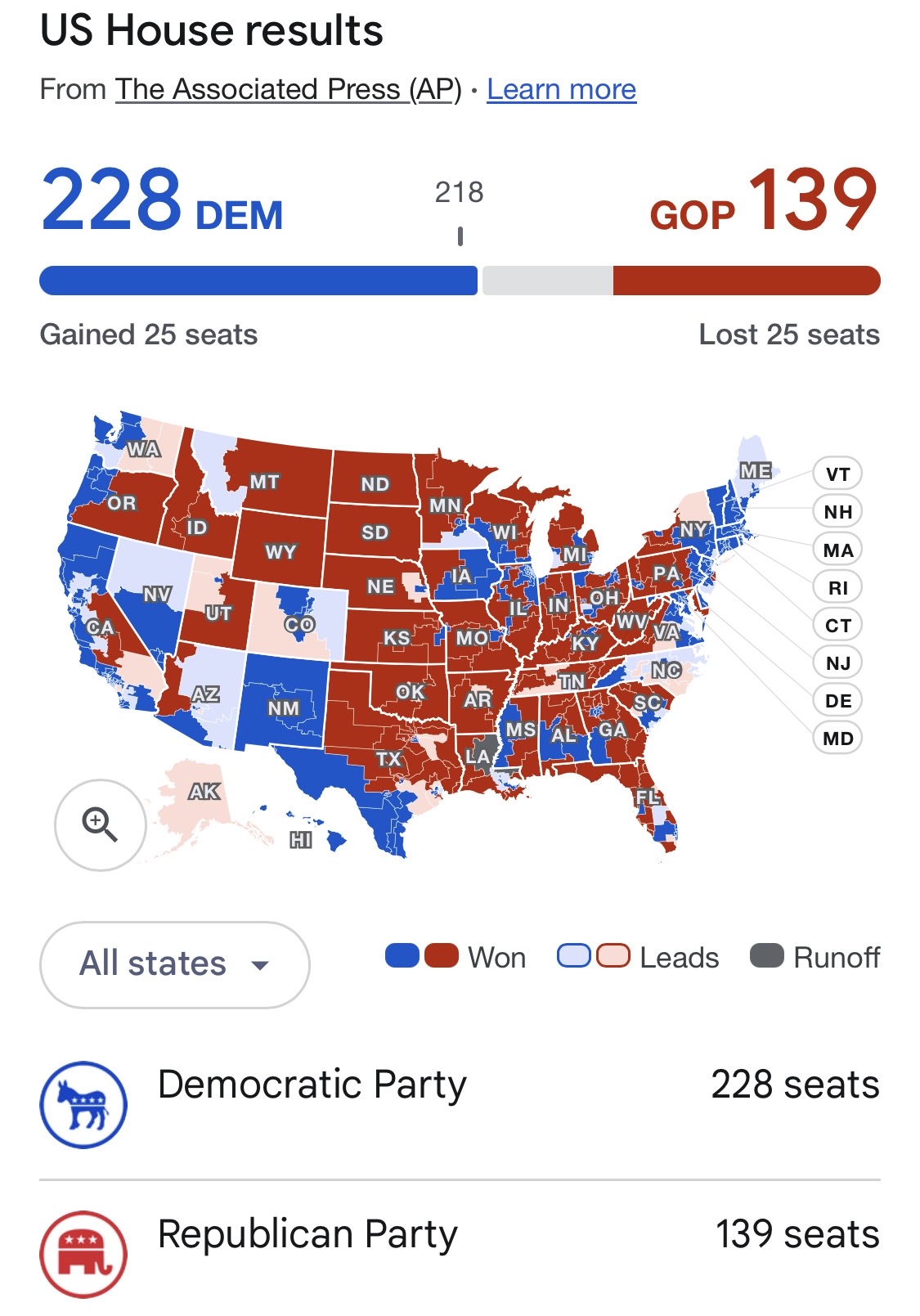
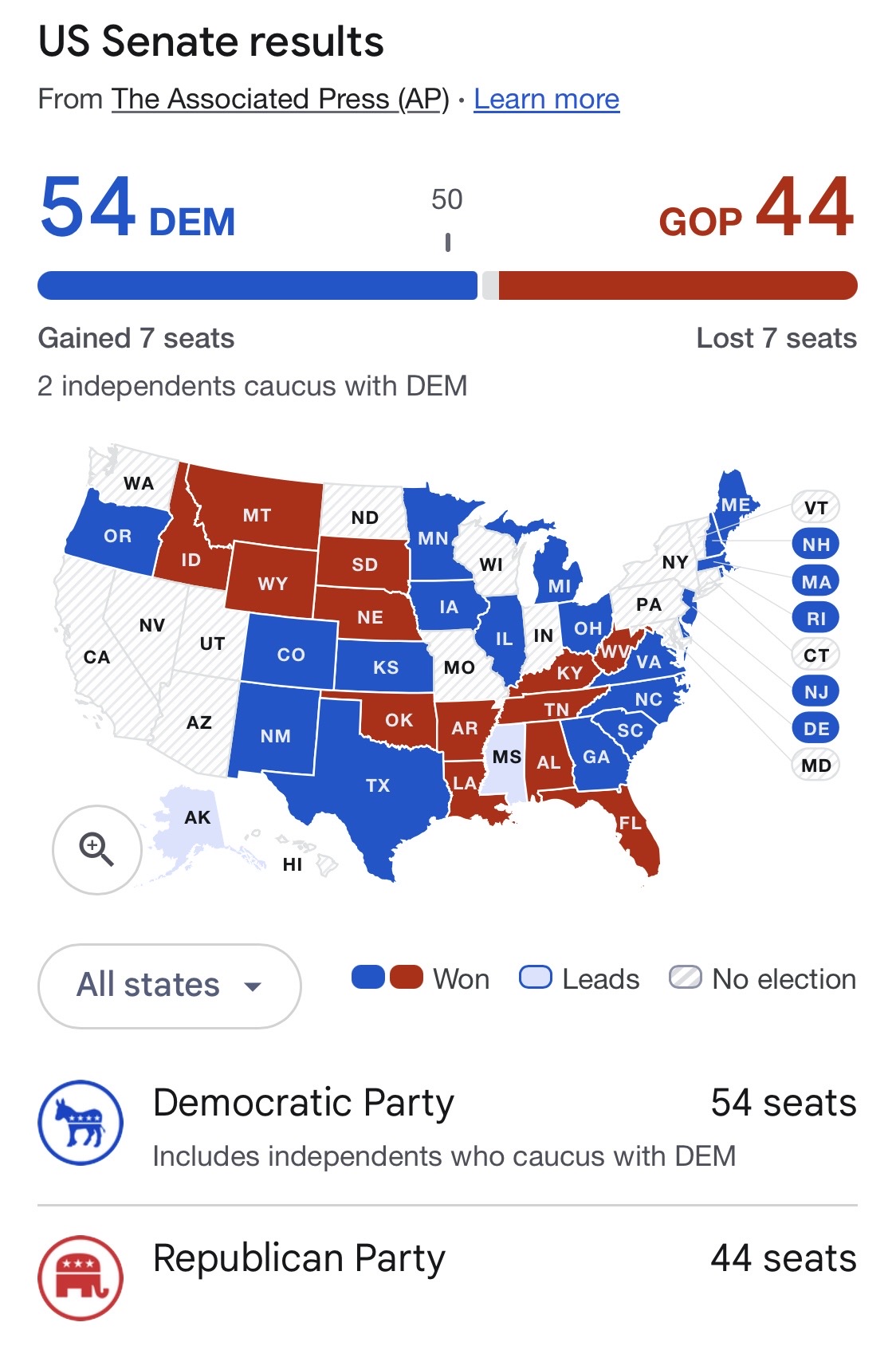
Skip the polite version. Democrats took back both chambers of Congress, capitalising on Donald Trump's historic unpopularity. If you're 25 and priced out of an apartment, or 45 and flinching at the gas pump, you didn't need a pundit to explain why. You voted with your wallet, and you did it in places nobody thought mattered.
Texas: the wall comes down
Nobody was supposed to be writing this paragraph. James Talarico became the first Texas Democrat elected to the U.S. Senate since 1988, and Gina Hinojosa will be the state's first Latina governor. Hinojosa beat Greg Abbott, ending more than three decades of Republican control of the governor's office. NBC's results even showed Democrats flipping the lieutenant governor's race, so this wasn't one lucky candidate. It was a ticket.
Now the part that must hurt Republicans most: the money. Elon Musk spent $212 million backing Ken Paxton, and his total bet on Texas Republicans came to roughly $224 million. Talarico flipped the seat even though Republicans vastly outspent Democrats in the most expensive race of the cycle. You can buy a megaphone. You can't buy a majority.
Down the ballot, Tejano singer Bobby Pulido beat Monica De La Cruz in the 15th District, in South Texas, where Republicans had hoped to gain seats after a controversial redrawing of district lines. They redrew the map to win, and the map didn't care.
Texas wasn't alone. Abdul El-Sayed won Michigan's Senate seat, becoming the first Muslim senator in US history. Sherrod Brown beat Jon Husted in Ohio, 50% to 45%, and Ossoff beat Mike Collins in Georgia, 59% to 41%. Democrats also flipped seats in Iowa, South Carolina, Maine, North Carolina and Kansas. When South Carolina is on the list, "red state" stops meaning much.
The war nobody asked for.
Here's what the exit polls say, and it's brutal. About 74% of voters said the Iran war was a crucial or major factor in their vote, and 62% said using force was the wrong decision. 87% said they were concerned about gas prices. CBS's exit poll put Trump's approval at 38%.
Remember how this war was sold. The US and Israel launched a joint strike on Feb 28, with Trump announcing "major combat operations." House Speaker Mike Johnson said it would be wrapped up soon and would be a "blip."
A ceasefire took hold in April, then Trump declared it over on July 8 and ordered fresh strikes. A war promised in weeks became a war measured in seasons, and voters paid for it at the pump.
To be fair to the numbers, the war wasn't the only story. About half of voters called the cost of living and government corruption crucial, against about a third for the war. But that's the point.
Prices, corruption and a war nobody voted for are one story: an administration spending your money on its own priorities. The war turned unpopular among Republican voters too, especially young ones.
The coalition that walked out: young, Hispanic and Black voters
Trump's 2024 win was built on a promise: the young, the Hispanic and the working class were done with the old politics. Last night they showed what that promise was worth.
Young voters were the loudest signal. About 71% of voters under 30 backed the Democrat in their House race, against 25% for Republicans, a margin of roughly 46 points. In 2024, the youngest voters were roughly split between Trump and Harris. The shift is most striking where Republicans thought they were safe. Young men went 63% Democratic, while 56% had supported Trump in 2024. White youth went 62% Democratic, after backing Trump 54% to 44% in 2024. Even rural youth, who voted 64% Republican in 2022, split 57% to 37% for Democrats this time. Non-college youth, the group the MAGA movement claimed as its own, went 69% Democratic.
But let's be honest about the limits, because an argument is only as strong as its weakest number. Voters under 30 were only about 10% of the electorate, down from 12% in 2022. Voters 45 to 64 split almost evenly, and voters 65 and older leaned Republican, 51% to 47%. Young voters didn't win this election alone. They gave Democrats a landslide margin in one corner of the electorate while older voters were already walking away from Trump in numbers big enough to flip states.
Hispanic voters were the difference in Texas. About 6 in 10 Hispanic voters backed the Democratic House candidate nationally, and about one-third backed the Republican. In 2024, roughly 4 in 10 had voted for Trump, though that's a presidential-versus-House comparison, not a like-for-like one. Among Latino voters under 30, 77% voted Democratic.
Texas is where it showed. Trump had flipped Cameron and Hidalgo counties in the Rio Grande Valley in 2024, and most analyses had Texas Latinos splitting close to evenly between him and Harris. By October, a CBS poll showed only 34% of Texas Latinos approved of his job performance. And in the Fort Worth area, an earlier special election saw the Democrat win around 79% of Hispanic voters, a 26-point gain over Harris. That's why Bobby Pulido won in South Texas, why Talarico and Hinojosa won statewide, and why Republicans' redrawn map didn't save them.
The caution for Democrats: Texas strategists say this swing is driven more by anger at the party in power than loyalty to Democrats, and candidates mattered more than party. Voters who left Trump can leave you too.
Black voters turned out. Early voting in North Carolina, Georgia, Florida and Louisiana showed Black voters casting more than 160,000 additional ballots compared with the same point in 2022, according to early turnout figures. Black voters under 30 went 89% Democratic. In Georgia, where Black turnout is decisive, Ossoff won 59% to 41%.
The argument: The 2024 Republican strategy was to win by peeling off the voters Democrats took for granted. This election suggests those voters weren't converted; they were borrowed. Prices, a war, and a sense that nobody was listening sent them home.
The South and the farm belt: the red wall cracks
Look at the map, because the states that fell tell a story: Texas, North Carolina, South Carolina and Kansas, plus Iowa and Ohio. These are the places Republicans treated as permanent.
Kansas is the headline.
Adam Hamilton, a pastor who founded the largest United Methodist church in the country, beat incumbent Sen. Roger Marshall. He is the first Democrat to win a Kansas Senate seat since 1932, in what AP called the most expensive race in the state's history, about $110 million. Hamilton ran on affordability and openly on his faith, while Kansas farmers and truckers were hit by record-high diesel and fuel prices. Marshall had backed Trump's agenda and funding cuts despite promising to expand rural healthcare.
The farm squeeze was real, and it connects back to the war. The Strait of Hormuz closure pushed fertiliser prices up in the middle of spring planting. One University of Arkansas economist found urea peaked about 39% above budget and diesel averaged about 72% above budget across the season. Farm bankruptcies in the first three quarters of 2026 were up 19% from a year earlier and 73% from 2024. These come on top of the tariff pain of 2025, when Trump announced $12 billion in tariff-related aid.
Then came the election-season check. In the weeks before the vote, the administration promised about $15 billion for producers, including an $8 billion one-time payment for farmers hit by high diesel prices. Farmers were relieved to stay in business, but experts say they see it as temporary, not a fix for the broader price pressures. As an Emporia State political scientist put it, Trump wasn't on the ballot, but his policies were.
AIPAC: the most expensive lesson in lobbying
Let's talk about the elephant in every primary room this year, carefully, because this debate has two lazy versions and both are wrong. The lazy-left version treats a lobby as a puppet master. The lazy-right version treats any criticism as bigotry and even anti-Semitism. The real story is about money in politics.
AIPAC spent at least $104.3 million during the 2026 cycle, not counting super PACs it quietly bankrolls. More than $30.6 million went into Michigan's Democratic Senate primary, the most it has ever spent on a single race. The target was El-Sayed. He won anyway. He narrowly defeated Rep. Haley Stevens despite a record-setting $60 million in outside spending in her favour. Then a super PAC that reportedly began receiving AIPAC money after the donor disclosure cutoff spent $12.7 million attacking him in the general election.
AIPAC rejects the suggestion that its influence is collapsing, saying hundreds of candidates it backed have won their primaries.
The deeper shift is in tactics. AIPAC has announced it will no longer officially endorse or contribute directly to candidates. When ads often don't mention Israel at all, voters are entitled to ask who is paying and why. Asking that about a registered lobbying group is legitimate. It's not an attack on Jewish Americans, and the lobby's best defenders should say so loudly.
The Israel split inside the Democratic Party
This is where Democrats should be nervous, not smug. In July the House defeated an amendment to cut off aid to Israel, 314 to 104. That sounds like a win for the status quo. Read the fine print: 103 Democrats and one Republican backed it, a sharp departure from years in which Israel bills passed almost unanimously. Hakeem Jeffries opposed the measure but said American policy in the Middle East must change.
The public is moving too. An AP-NORC poll found around one-third of US adults, including roughly half of Democrats, believe Israel has committed genocide against Palestinians in Gaza, an allegation strongly rejected by Israel and the US government. In April, 13 centrist Democratic senators flipped to join Sanders on resolutions to block arms sales. But note that other than Sanders, none of those senators call for ending military aid. That red line remains.
Now Democrats own Congress. The pro-Israel wing and the young, angry wing both think the midterms vindicated them. They can't both be right.
The real story: repudiation
Republicans will say this is the usual midterm penalty, and they're half right. The president's party usually bleeds. But a normal midterm doesn't flip states Trump won by double digits two years ago. This was a repudiation of a brand built on three things: prices that never came down, a war that never ended, and a party so afraid of one man that it never told him no.
Even Trump seems to know. As Republican losses mounted, he distanced himself from them. The man who put his name on towers, steaks and universities suddenly can't find it on the scoreboard.
The investigations: my prediction
Subpoena season opens in January, and it's a different cast than a year ago. Kristi Noem is out: Trump removed her as Homeland Security secretary in March and replaced her with Sen. Markwayne Mullin. Pam Bondi is out too. But Democrats say the firings don't end anything. Rep. Robert Garcia said if they think Oversight Democrats are moving on because Bondi and Noem were fired, they are gravely mistaken. The allegations against Noem include steering a $220 million DHS ad contract to a firm linked to her and misleading Congress. They are allegations, and she hasn't been convicted of anything.
What's coming:
* Epstein hearings on day one.
* "Trump family corruption," Garcia says it will be a major focus.
* The White House stonewalls and fights in court. Subpoena lawsuits drag into 2028.
* Slow beats dramatic. An impeachment vote is a headline. Document-by-document exposure is the real danger.
Elon Musk: the man with the most to lose.
Musk lost his $224 million Texas bet, and he may soon lose something bigger. His reaction on election night was a single post: “data centres in space were looking pretty appealing”, he posted on X . Tesla and SpaceX shares dropped in after-hours trading as investors worried about stricter oversight and a delay to a rumoured Tesla-SpaceX merger.
Democrats have a long list:
1. DOGE. Musk aimed to cut $2 trillion, and DOGE ultimately claimed $215 billion in estimated savings. A GAO audit found it consistently overstated them. House Homeland Security Democrats demanded he testify under oath, and Ways and Means Democrats called for a probe into alleged DOGE-related data theft from Social Security.
2. The contracts. Lawmakers are eyeing SpaceX's billions in NASA spaceflight contracts and Tesla's clean-energy subsidies. One advocacy group's analysis found his companies got at least $10 billion in new government contracts and grants since he left DOGE.
3. Starlink and Ukraine. The WSJ reported that Musk allegedly ordered a slowdown of satellite service, which he denies.
Sen. Richard Blumenthal said he'd investigate Musk and DOGE if Democrats won. Musk's reply was a threat: "live by the sword, die by the sword." Trump has offered cover, saying he'd issue preemptive pardons for Musk and aides if Democrats pursue investigations, though how far that applies to some forms of congressional contempt is legally disputed.
My call: Musk is invited to testify early in 2027 and ignores it. The real danger isn't one hearing. Congress controls the money, and it could stop authorising spending on his contracts.
The caution Democrats should take seriously: Jeffries has kept the midterm message on affordability, not Musk. And Fox's Jesse Watters argues Democrats should be wary of targeting a man whose companies drive America's military edge. Make it a document's story, not a revenge story.
Trump's answer.
Expect these moves, probably in this order :
First, blame everyone else. People close to Trump, per the Wall Street Journal, blame the Iran war and energy prices for the losses. The people around him already see the cause. Don't expect him to say so himself.
Second, attack the investigators. Every subpoena is a "witch hunt," every hearing a "hoax." The White House fights them one at a time.
Third, a fork on Iran. Two weeks before the election he maintained the war ends when Iran agrees not to build a nuclear weapon. The question for the next 90 days is whether the loss makes him look for an exit that lowers gas prices or double down to avoid looking weak. My bet is a messy mix of both, with his own party quietly begging for the first.
Fourth, pardons. Expect him to dangle them for allies, starting with Musk. That turns every investigation into a fight over whether a president can shield friends from Congress.
Fifth, govern alone. More executive orders, more tariffs, more firings, and a bigger fight over how much power one president can hold. Inside the party, expect panic dressed up as loyalty, and 2028 jockeying starting now.
The other side's case.
Fairness demands the counterargument, and it isn't silly. Republicans will say midterm losses are historically normal, that Trump wasn't on the ballot, and that Texas was one cycle of money and candidate quality, not a realignment. On Iran, defenders say the goal is simple: make sure Iran doesn't have nuclear weapons and the Straits of Hormuz stay open. On Israel, supporters note the House kept the aid by a wide margin, and Steny Hoyer warned that ending military aid would weaken efforts against Hamas and Hezbollah.
On Musk, the administration and he defend DOGE as an effort to root out government waste. Some of this may prove right, and Democratic overreach could hand Trump a comeback story.
But a party that loses Texas, Ohio, Iowa and South Carolina in one night, with three in four voters saying a war it started mattered to their vote, doesn't have a messaging problem. It has been repudiated. And a repudiation, unlike a gerrymander, can't be redrawn.